

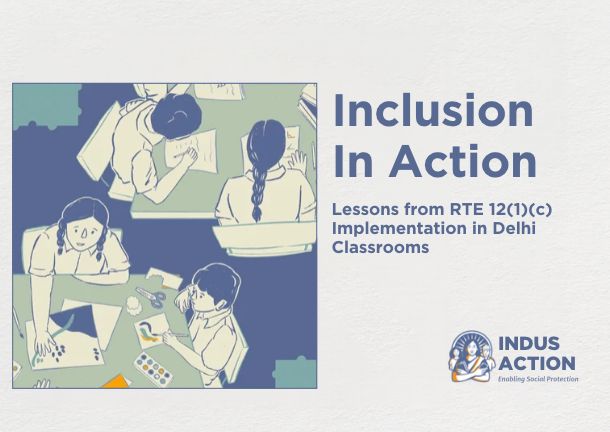
Education
Researchers identify the practices that work to strengthen inclusion through approaches that combine inclusive teaching, supportive leadership, equitable opportunities, and strong partnerships with parents…
Read More

Indus Action Initiatives
G-7, 2nd Floor, Lajpat Nagar III
New Delhi – 110024
 011 4172 9407
 info@indusaction.org


 English
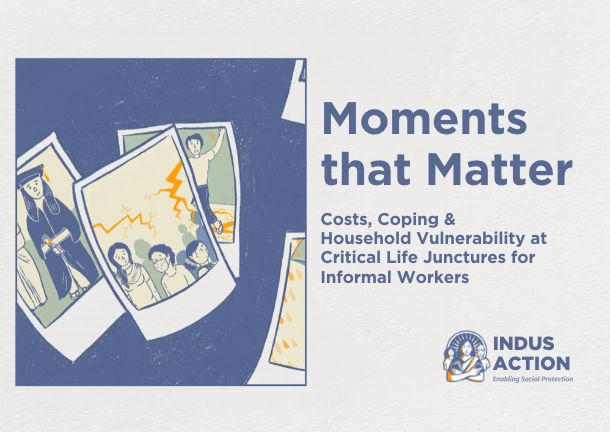
The COVID-19 pandemic exposed the deep fragility of informal work, pushing
millions back into chronic poverty. It became clear that compounding shocks
and entrenched vulnerabilities were not merely temporary setbacks, but
forces defining the long-term trajectory of household well-being. At that
critical juncture, Indus Action had already been working on implementing
the Right to Education (RTE 12.1.c) since 2013 and Maternal Health initiatives
(NFSA 2013) since 2019.
A persistent realisation emerged from our work: families cannot escape the
poverty trap without a comprehensive social protection net that secures
them across pivotal life moments or “moments that matter” (MTM). This
learning gave rise to our vision around consolidating a portfolio of welfare
schemes around MTMs to support households when they need it the
most. By expanding our focus to multi-scheme policies, including labour
entitlements (BOCW 1996 & UWSSA 2008) and strengthening digital public
service delivery, we have moved closer to making this holistic safety net a
reality.
This report is the first in a series of investigations designed to rigorously
test this vision. Through these efforts, we aim to delve deeper into our
hypotheses regarding household vulnerability and the capacity of the MTM
approach to social protection for fostering genuine resilience.
Authors: Umang Kamra, Rahul K Sharma, Anany Kapoor, Niyoshi Parekh
Education
Researchers identify the practices that work to strengthen inclusion through approaches that combine inclusive teaching, supportive leadership, equitable opportunities, and strong partnerships with parents…
Read More
Events
Lives do not change gradually. They change during moments of transition and disruption: when a household faces a sudden shock, navigates a key life…
Read More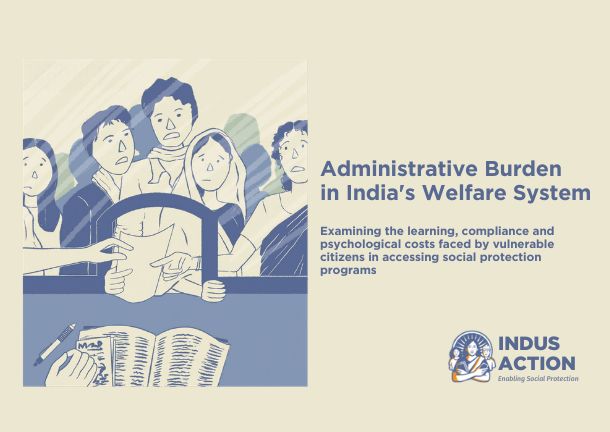
Systemic learnings
Administrative burden refers to the learning, compliance, and psychologicalcosts that citizens incur when interacting with government programs andservices. These costs accumulate across stages, leading…
Read More