

Education
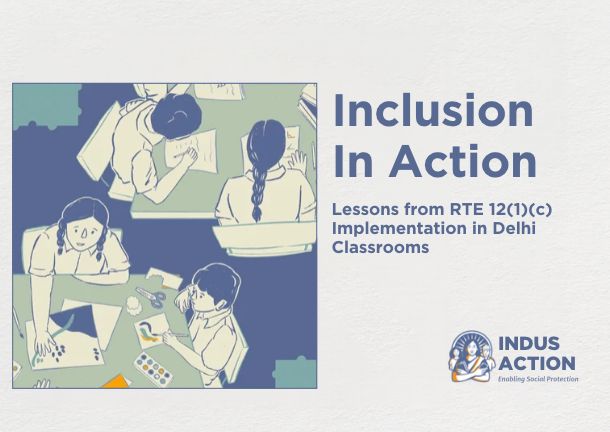
Researchers identify the practices that work to strengthen inclusion through approaches that combine inclusive teaching, supportive leadership, equitable opportunities, and strong partnerships with parents…
Read More

Indus Action Initiatives
G-7, 2nd Floor, Lajpat Nagar III
New Delhi – 110024
 011 4172 9407
 info@indusaction.org


 English
The report discusses two schemes broadly, RTE 12.1.c and EWS Freeship. RTE 12.1.c, which is a part of the Right to Education Act 2009, states that 25 percent of seats in private schools are to be reserved for children from EWS (Economically Weaker Sections) and DG (Disadvantaged Groups) categories of society. DG is further divided into subcategories, which will be defined further on. Through this scheme, children are allotted seats only at the entry grade level (age group: 3–7). The EWS Freeship scheme was announced by the Delhi Government in 2019 to admit children from the EWS category to seats that had been left vacant under RTE 12.1.c, across grades II to IX. Education is completely free under both provisions.
Indus Action began its work on RTE 12.1.c in 2013 under Project Eklavya. Since 2013, Project Eklavya has supported thousands of children in obtaining admission into private unaided schools and bolstering the implementation of Section 12(1)(c) of the Right to Education Act, 2009. In 2017, the organization conducted its first Retention Survey to assess whether children admitted over the previous five academic years were still studying in their respective private schools.
Education
Researchers identify the practices that work to strengthen inclusion through approaches that combine inclusive teaching, supportive leadership, equitable opportunities, and strong partnerships with parents…
Read More
Events
Lives do not change gradually. They change during moments of transition and disruption: when a household faces a sudden shock, navigates a key life…
Read More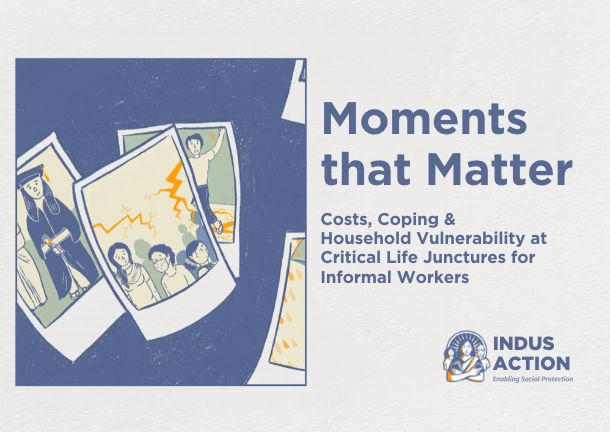
Systemic learnings
The COVID-19 pandemic exposed the deep fragility of informal work, pushingmillions back into chronic poverty. It became clear that compounding shocksand entrenched vulnerabilities were…
Read More